“That command is out of date.”
Setup and validation instructions survived the migration. Your agent is still following them.
Inspect: stale operational guidanceFOR TEAMS ALREADY BUILDING WITH CODING AGENTS
GitHub Copilot / Claude Code / Codex
One agreed agent environment per audit01 / THE FRICTION
Your engineers should not have to explain the same repository rules every time they delegate a task.
Setup and validation instructions survived the migration. Your agent is still following them.
Inspect: stale operational guidanceThe architecture decision exists. The path from the agent's instructions to that decision does not.
Inspect: missing context routesUseful knowledge is buried in chat history, repeated across files, or contradicted by another instruction.
Inspect: gaps and conflicting rulesContext is one possible cause. The audit separates supported findings from issues that need a live workflow test.
02 / SEE THE WORK
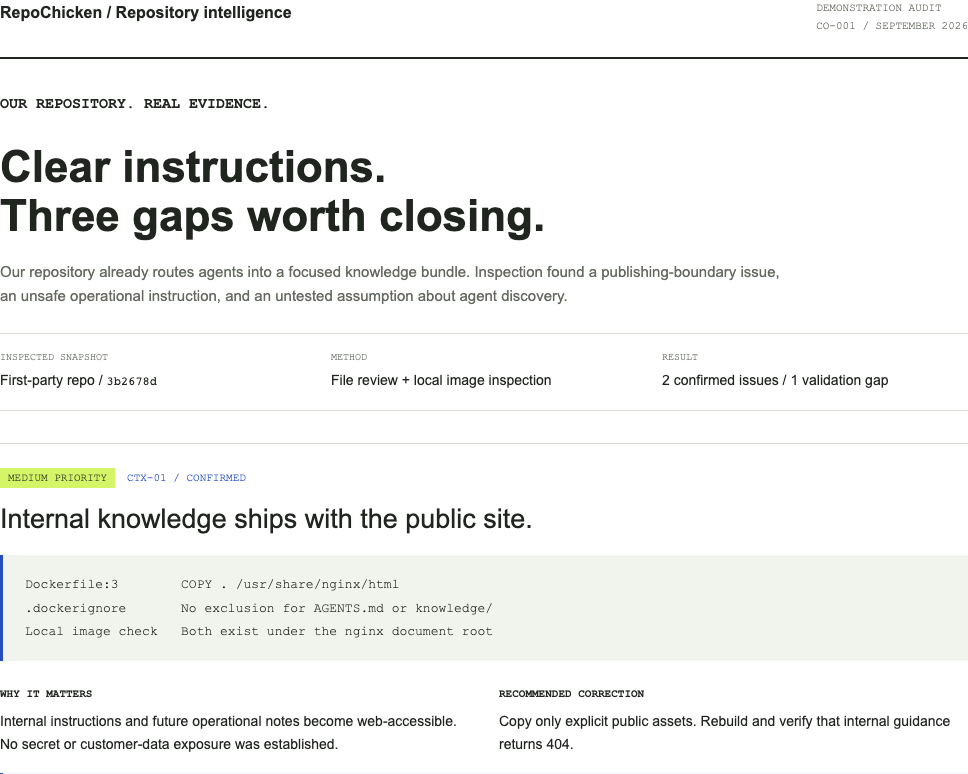
This is an audit of our own repository. Every finding points to inspected evidence, explains its consequence, and proposes a checkable correction.
First-party demonstration. No customer results or productivity claims.
03 / WHAT YOU RECEIVE
A repository context audit compares agent instructions and supporting knowledge with the codebase they describe. You receive a practical handoff for the engineers who will make the changes.
Entry points, instruction scope, knowledge routes, and where the selected agent's behavior still needs verification.
INVENTORYFile-level references, conflicting or stale guidance, likely consequences, and confidence in each conclusion.
AUDIT REPORTWhat to keep, change, move, or remove. Each recommendation includes priority and an acceptance check.
REMEDIATION PLANWalk through the findings together, resolve questions, and agree which hypotheses to validate next.
REVIEW SESSIONThe audit identifies and recommends changes. Implementation and controlled before/after agent runs are separately scoped. Read the repository context guide.
04 / HOW IT WORKS
Choose a repository, an agent environment, and up to three workflows your team wants to improve.
Review a fixed snapshot. Trace instructions to code, commands, and the knowledge they reference.
Receive the findings and prioritized plan, with acceptance checks your engineers can use.
Discuss the findings and decide whether your team or a separate implementation engagement takes them forward.
05 / FOUNDING CUSTOMER AUDIT
A focused first engagement for engineering leaders who want a concrete plan before investing in a broader rollout.
A good fit: an active codebase, an existing coding-agent workflow, and an engineer available to explain the recurring friction.
Not a security audit, code-quality review, or guarantee of agent performance.
PROPOSED PILOT PACKAGE
Illustrative offer for this local prototype. Price and delivery timing are not validated commitments.
Contact: michael@mybfchef.com. No booking or payment is taken.
First step: share your setup and recurring friction. Scope and access would be agreed before work begins.
06 / BEFORE YOU START
Generating instructions is one step. The audit checks whether those instructions match your repository, conflict with other guidance, and lead to usable workflow knowledge. The handoff includes evidence and acceptance checks so your team can judge the recommendations.
A read-only repository snapshot, the relevant agent configuration, and examples of the friction you see. An exported or redacted snapshot can be discussed; missing material limits what we can conclude. Running commands or agent trials requires a separately agreed environment.
Before a real engagement, we would agree access, permitted tools and model providers, retention, and deletion in writing. This local prototype does not accept repository uploads. Our demonstration uses only our own repository.
It can identify unnecessary context and actionable instruction problems. A reduction in file size is not proof of faster work, lower billed tokens, or better task completion. Those outcomes need repeated, controlled runs in your actual environment.
The proposed audit includes findings, recommendations, acceptance checks, and a handoff session. Your team can implement the plan. Any implementation work or before/after agent evaluation would be agreed separately.
No. Recommendations should fit your repository and tools. Open Knowledge Format can help organize knowledge for selective reading, but adopting it is not a condition of the audit. There is no platform subscription.
No. Any future use of anonymized findings would require explicit permission. A case study is optional and separate from the audit.
GIVE YOUR TEAM A CLEARER STARTING POINT.